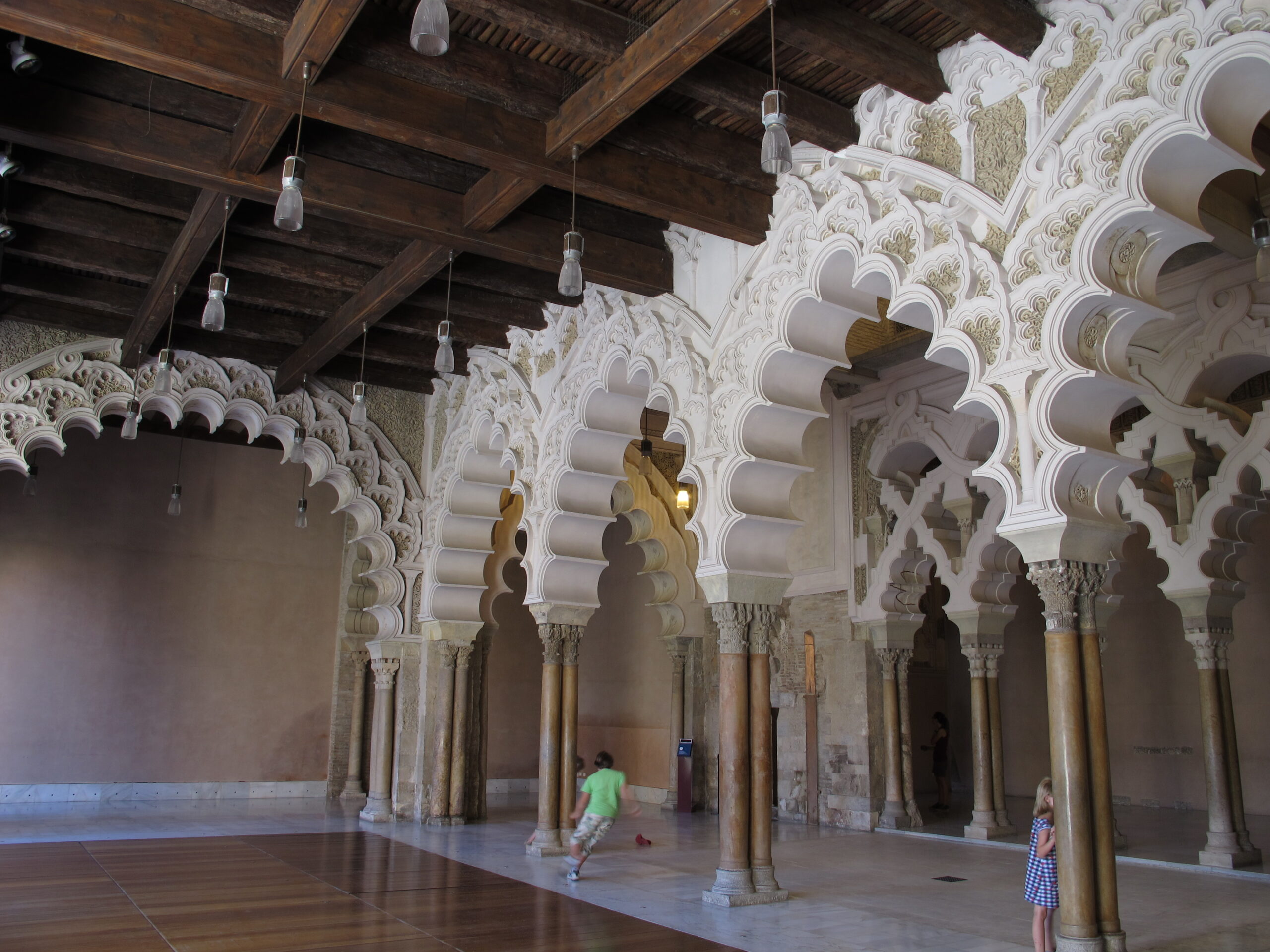

Place Summary
Taifa palace in Zaragoza later adapted by Christian rulers.
Why This Place Matters
Aljaferia is a core taifa-era monument for understanding how architecture expressed court legitimacy during political fragmentation. It anchors Zaragoza's importance as a regional center in the post-caliphal landscape.
For archive users, it is one of the clearest examples of layered reuse: Islamic palace fabric, later Christian adaptation, and modern heritage framing in one site.
It also helps break a common shortcut in public memory. When readers hear "Moorish Spain," they often jump immediately to Cordoba or Granada. Aljaferia widens the frame by showing how taifa courts outside those better-known centers produced sophisticated political and artistic programs of their own.
Historical Context
The palace emerged within taifa political culture and later passed through Christian royal and administrative contexts. This long sequence makes it especially useful for studying continuity and transformation rather than one-period snapshots.
Its surviving forms are often used in modern media to stand in for "Moorish architecture" as a whole. That shortcut hides the specific taifa court setting that produced the site and the later interventions that reshaped it.
As a taifa monument, the palace belongs to a world after caliphal unity had collapsed but before later dynasties reorganized power on a larger scale. Courts needed to project refinement, legitimacy, and stability under fragile conditions. Architecture was part of that work. Aljaferia therefore teaches not only style, but political competition under fragmentation.
Evidence Frame
Aljaferia must be read by phase. Strong claims identify original taifa components versus later modifications, and separate present-day presentation from medieval function.
Readers should also avoid treating decorative survival as proof that politics stayed the same. The building's later reuse by Christian rulers is part of the point. Continuity in form can coexist with deep shifts in authority, patronage, and meaning.
What to Look For
- Taifa-era court architecture and political messaging.
- Christian-period adaptation layered onto Islamic structures.
- Zaragoza's role in post-1031 regional power networks.
- Heritage framing versus period-specific evidence.
What This Place Should Teach
Aljaferia should teach readers to connect architecture with political scale. The palace makes more sense when read as a product of taifa rivalry, courtly self-fashioning, and later appropriation than when treated as a free-floating example of "Islamic beauty." The narrower reading is also the more historically useful one.
Related Reading
- The Taifa Period Explained: Politics, Patronage, Rivalry (11th c.)
- What Is Moorish Architecture? A Careful Definition
- Architecture Images: What They Can and Cannot Prove