Editorial Summary
Arabic left visible traces in Spanish and Portuguese vocabulary and in place-name memory, but those traces need careful handling. A word can survive because of administration, agriculture, craft, trade, geography, translation, conquest, or later usage. It should not be made to prove more than the evidence allows.
What This Page Establishes
This page establishes words and place names as clues rather than shortcuts. They can point readers toward contact, borrowing, settlement, power, and memory, but the site should still ask when a word entered a language, how it changed, and what social setting carried it forward.
Historical Context
Arabic entered Iberian Romance languages through long contact across Muslim-ruled and Christian-ruled zones, frontier exchange, administration, agriculture, crafts, science, translation, and post-conquest life. Place names preserve another layer of contact, especially where geography, settlement, fortification, and later political memory kept older names visible.
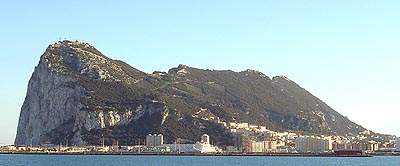
The Strait offers a useful example of why caution matters. Gibraltar is associated with Jabal Tariq in later tradition, but the place record, conquest narrative, and language history each need to be handled as related but separate forms of evidence.
Evidence Frame
Etymology can be powerful, but it is also easy to misuse. A word's origin, route of borrowing, later pronunciation, and modern meaning may all differ. Place names add another difficulty: a name can survive after political control, population, language use, and meaning have changed.
What to Ask While Reading
- Is the claim about a word, a place name, a custom, a building, or a whole culture?
- What is the earliest evidence for the word or name?
- Did the meaning shift after borrowing?
- Is the example being used as a clue or as an overlarge proof?
What Sources Let Us Say
Sources let us say that Arabic contributed visibly to Iberian language and memory. They also let us place those survivals inside broader histories of al-Andalus, Christian conquest, translation, craft, agriculture, administration, and later cultural reuse.
What Remains Cautious
A borrowed word is not a genealogy test, a property claim, or proof that an institution remained unchanged. The site should avoid turning lists of Arabic-derived words into a blanket argument that "the Moors built everything" or that every survival has the same depth.
Working Conclusion
Words and place names are excellent entry points because readers notice them quickly. They become historically useful when each example is tied to a period, place, source trail, and narrower claim.

_-_panoramio.jpg)