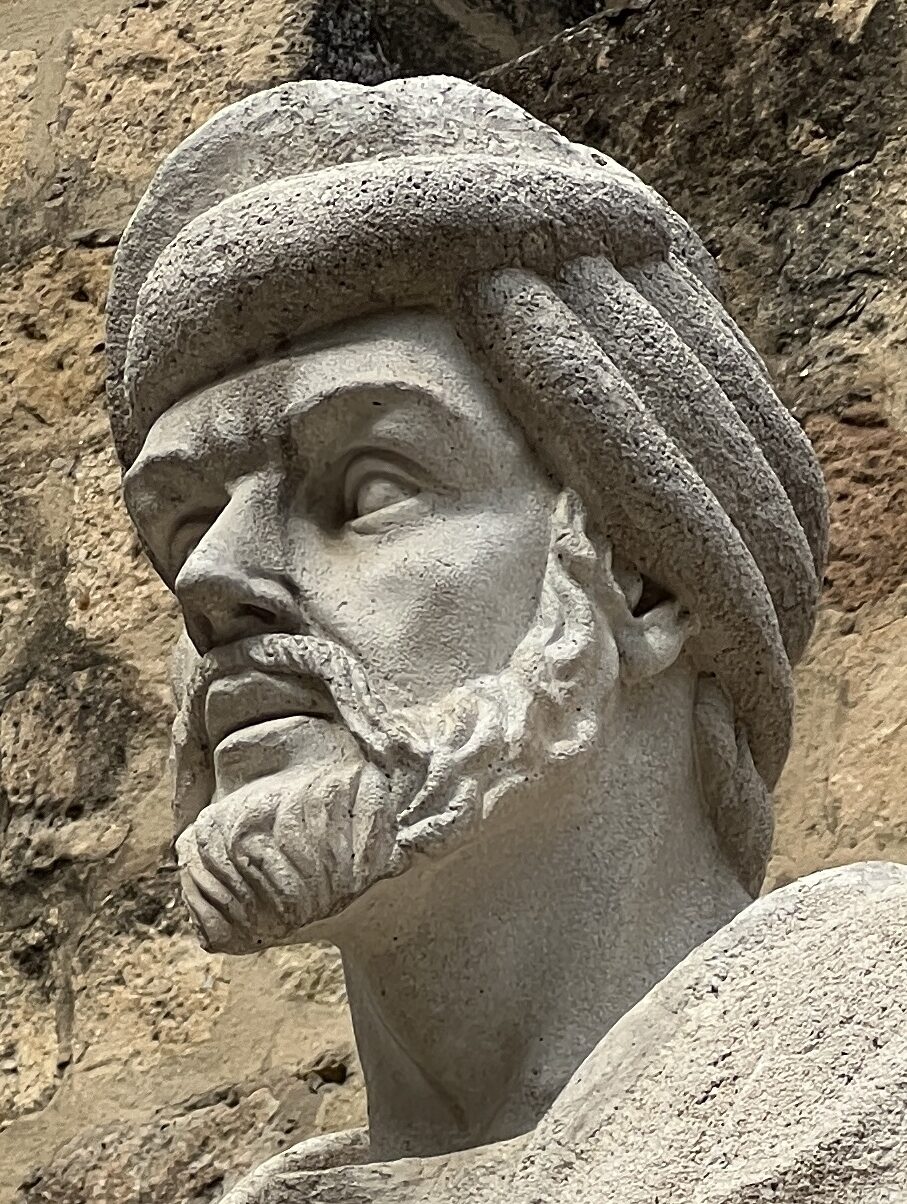
(cropped).jpg)
Ibn Rushd, known in Latin tradition as Averroes, was a Cordoban jurist, physician, and philosopher. He matters because his commentaries, legal writing, and court career show how al-Andalus participated in a wider Mediterranean life of scholarship, translation, and debate.
Why This Person Matters
Ibn Rushd helps readers connect Andalusi learning to law, medicine, philosophy, and later European reception. His reputation also shows how one author's afterlife can differ sharply across Arabic, Hebrew, and Latin intellectual traditions.
For Moor History Center, Ibn Rushd is useful because he prevents a flat story about "Moorish learning." He was not simply a symbol of tolerance or a name in a list of famous scholars. He was a working judge, a physician connected to elite patronage, and an author whose books moved through courts, libraries, translators, critics, and later universities. His life shows that knowledge in al-Andalus was institutional, contested, and mobile.
Historical Context
Read this profile through Almohad-era court culture and scholarly networks, where philosophical inquiry, religious authority, and political patronage could support one another but also collide. His work belongs to institutions, teachers, patrons, and readers, not a lone-genius myth.
Ibn Rushd was born in Cordoba in 1126, into a family associated with legal office and learned service. His career unfolded under Almohad rule, when al-Andalus was linked politically to North Africa and intellectually to a much larger Arabic scholarly world. That setting matters: his writing was not isolated from power. It was shaped by courts, judgeships, medical service, and the expectations placed on scholars who operated near rulers.
He is best known for his commentaries on Aristotle, but his importance is wider than philosophy alone. His legal work, including discussions of disagreement among jurists, shows a mind trained in Islamic law as well as Greek philosophical materials. His medical writing also places him in a technical tradition where learned medicine, practical treatment, and inherited textual knowledge overlapped.
Major Works and Roles
Ibn Rushd wrote across several fields. His philosophical commentaries made Aristotle more legible for later readers; his response to al-Ghazali defended philosophical inquiry against influential criticism; his legal writing compared arguments across schools; and his medical work participated in a learned tradition that moved between Arabic and Latin readerships.
Those roles should be read together. A judge who wrote about law, a physician who served courts, and a philosopher who explained Aristotle were not three separate people. They were parts of one career in a world where elite learning could be both prestigious and vulnerable.
Reception and Afterlife
Ibn Rushd's afterlife is one reason his page matters. In Latin Europe, "Averroes" became a major name in debates about Aristotle, reason, the soul, and the boundaries of acceptable philosophy. In Jewish intellectual circles, translations and interpretations also kept parts of his work alive. In Arabic tradition, his philosophical reputation did not develop in exactly the same way, even though his legal and medical writings remained important.
That uneven reception is a good reminder that influence is not one straight line from Muslim Spain to Europe. Texts moved through translators, teachers, manuscript cultures, polemics, and institutional needs. Later readers often made Ibn Rushd serve arguments that were not identical to his own.
What We Can Say With Care
The record supports Ibn Rushd's importance as a major scholar and commentator. The page should avoid flattening him into a modern slogan about "reason versus religion"; his work moved through medieval categories of law, theology, medicine, and philosophy.
It is also better to avoid making him a solitary hero of "Western rationalism." That modern frame hides the Arabic, Islamic, Andalusi, Maghrebi, Hebrew, and Latin contexts that all shaped his legacy. The stronger claim is more specific: Ibn Rushd was a major Andalusi scholar whose works became unusually mobile across languages and institutions.
Evidence Limits
Names, titles, spellings, and reputations often shift across Arabic, Latin, Romance, Hebrew, and modern scholarly traditions. Treat exact anecdotes cautiously unless a source trail is clear.
Connected Reading
Use this page as a bridge into the relevant places, timeline events, articles, and source records.
Sources and Further Reading
- Averroes. Decisive Treatise and Epistle Dedicatory
- Averroes. The Incoherence of the Incoherence
- Glick, Thomas F. Islamic and Christian Spain in the Early Middle Ages (2nd ed.)
- Kennedy, Hugh. Muslim Spain and Portugal
- Catlos, Brian A. Kingdoms of Faith
- Bennison, Amira K. The Almoravid and Almohad Empires