
Tariq ibn Ziyad is one of the most recognizable names in the opening history of al-Andalus, but the evidence for his life is thinner and later than popular retellings often suggest. He matters because his name anchors the 711 crossing story, not because every famous anecdote about him can be treated as settled fact.
Why This Person Matters
Tariq ibn Ziyad helps readers orient themselves at the start of Muslim-ruled Iberian history. His profile opens into questions about conquest narratives, later memory, and how medieval chroniclers turned a commander into a foundational figure.
He also matters because he is one of the clearest examples of how a historical figure can become larger and cleaner in memory than in evidence. For many readers, Tariq is the first named actor in the story. That makes this page a good place to teach source caution early rather than after legends have already hardened.
Historical Context
Read Tariq through early Umayyad military expansion across North Africa and into Iberia, where commanders, governors, and local alliances operated inside a fast-moving political world. Much of what later readers think they know about him comes through retrospective narrative rather than contemporary biography.
That setting was not a neat national invasion story. It involved North African mobilization, provincial command structures, unstable Visigothic politics, and later efforts by chroniclers to impose coherence on a rapidly changing frontier. Tariq belongs inside that world, not outside it as a solitary conquering hero.
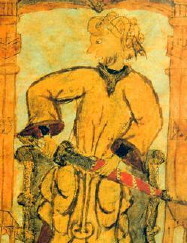
The featured image is a later European miniature. Like many images of early conquest figures, it should be treated as evidence of later imagination. It is useful precisely because it reminds readers that famous founders are often visually reconstructed long after their own time.
What We Can Say With Care
The record supports a careful claim that Tariq was associated with the early conquest phase and later became a major memory figure in the story of al-Andalus. It is less secure when asked to confirm every speech, gesture, or dramatic legend attached to his name.
It is also careful to distinguish between Tariq as a commander in a campaign and Tariq as a symbol attached to Gibraltar, crossing narratives, and civilizational origin stories. Those are related, but they are not the same level of evidence.
Evidence Limits
Names, titles, spellings, and reputations often shift across Arabic, Latin, Romance, Hebrew, and modern scholarly traditions. Treat exact anecdotes cautiously unless a source trail is clear. Famous claims about speeches, burned ships, or perfectly mapped invasion routes belong in the "needs source review" category unless tied to a specific source tradition.
The "burning the ships" story is the best-known example of the problem. It is memorable, teachable, and often repeated, but that is exactly why it needs source discipline. A good Tariq page should show readers how to separate what is narratively satisfying from what is securely evidenced.
Another limit is that later identity debates often recruit Tariq for arguments about ethnicity, conquest, legitimacy, or civilizational inheritance. Some of those debates ask real historical questions, but many lean too hard on a figure whose biography is not fully recoverable.
What To Watch For
- Later chroniclers turning campaign memory into origin story.
- Geography around Ceuta and Gibraltar as anchor points, not proof of every legend.
- The difference between a named commander and a fully documented biography.
- How conquest narratives simplify multi-actor political change.
Connected Reading
Start with the 711 crossing event, then read Gibraltar and Ceuta as geographic anchors. The conquest-and-consolidation article gives the beginner route, while the maps-evidence page explains why later conquest maps should not be treated as documentary snapshots.