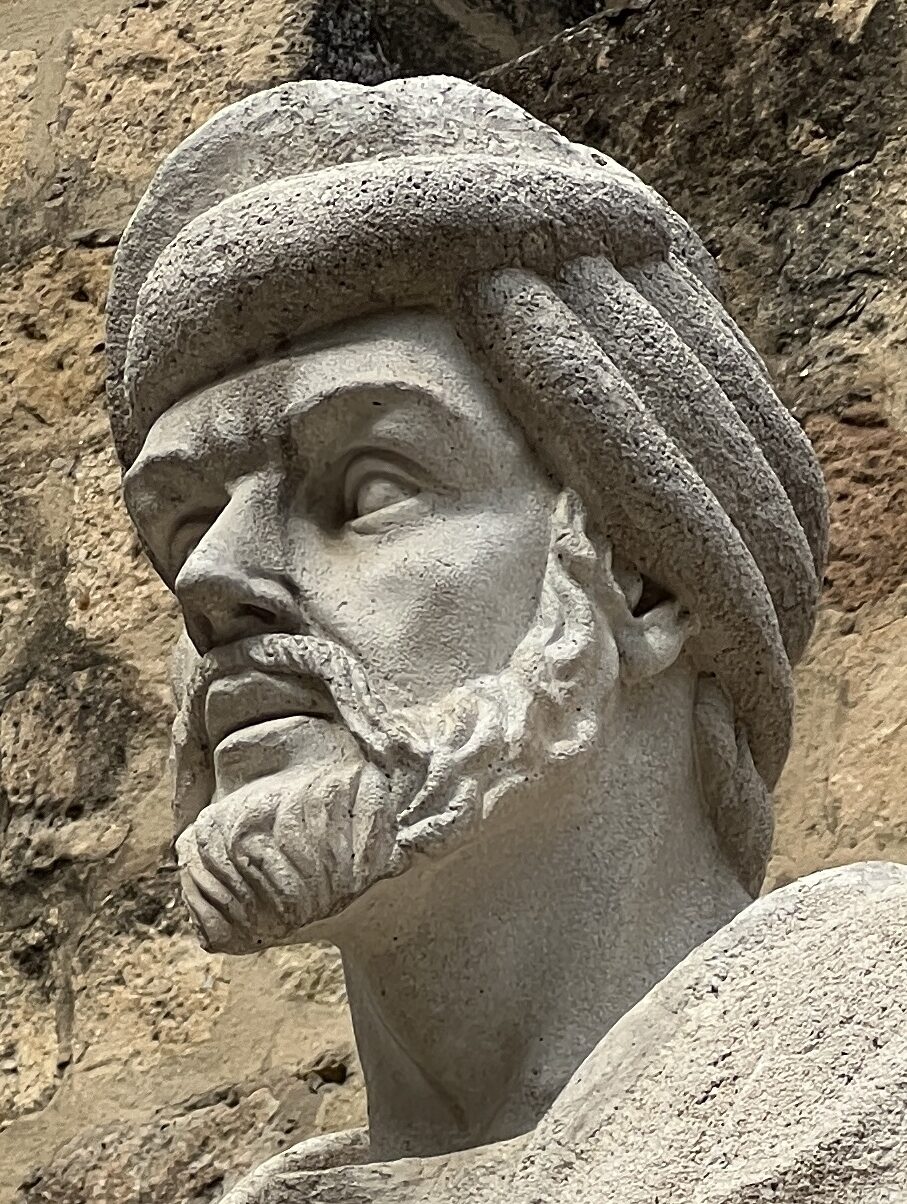
Editorial Summary
Ibn Rushd, known in Latin as Averroes, became one of the most debated philosophers to emerge from al-Andalus. The phrase "philosophy wars" is useful only if it points to real texts and real medieval arguments: the relationship between revealed law and demonstrative reasoning, the status of Aristotle, the critique of philosophers by al-Ghazali, and the later Latin reception of Averroes.
What This Page Establishes
This page gives readers a stable frame for Ibn Rushd's philosophical importance without turning him into a modern culture-war mascot. He was a Cordoban jurist, physician, commentator, and court-connected scholar whose work moved through Arabic, Hebrew, and Latin intellectual worlds.
Historical Context
Ibn Rushd worked in an Almohad-era setting where al-Andalus and the Maghreb were politically connected. Court patronage, legal service, scholarly reputation, and religious authority all mattered. Philosophy was not a private hobby sealed off from institutions; it was pursued by scholars whose public roles could make their writings prestigious and vulnerable.
That is why the page should not begin with "Europe rediscovered Aristotle" and stop there. Ibn Rushd's story begins in Arabic intellectual life, Islamic law, medicine, court service, and Andalusi-Maghrebi politics. His Latin afterlife is important, but it is an afterlife.
Evidence Frame
The two key source anchors here are the Decisive Treatise and The Incoherence of the Incoherence. The first argues that properly qualified inquiry into philosophy can be supported by revealed law. The second responds to al-Ghazali's attack on the philosophers. Neither text should be reduced to "religion versus reason." Both work inside medieval categories of law, interpretation, demonstration, theology, and inherited philosophical argument.
The Decisive Treatise
The Decisive Treatise matters because Ibn Rushd frames philosophy through legal-religious reasoning. He argues that reflection on beings and demonstration can be required for those capable of it, because such inquiry helps people understand creation and the maker of creation.
That argument is not secular in the modern sense. It does not ask readers to abandon revelation. It asks how revelation, interpretation, and demonstrative knowledge relate when apparent conflict appears. For a careful site, this is where the page can avoid the lazy version of the story: Ibn Rushd was not simply "against religion." He was arguing about who may interpret, how certainty is reached, and what kind of readers are qualified for different kinds of discourse.
The Incoherence Debate
The Incoherence of the Incoherence is Ibn Rushd's reply to al-Ghazali's Incoherence of the Philosophers. The debate turns on difficult questions: eternity of the world, causality, divine knowledge, resurrection, and the authority of philosophical demonstration.
This exchange is a real intellectual conflict, but not a cartoon battle between enlightenment and darkness. al-Ghazali was himself a sophisticated thinker, and Ibn Rushd's response is a technical work of argument, commentary, and critique. The useful question is not "who was modern?" but "what claims did each thinker make, and how did later readers reuse the debate?"
Latin Averroes
In Latin Europe, Averroes became a major authority on Aristotle. His commentaries and name circulated in university debates, and later critics sometimes used "Averroist" as a label for positions they opposed. That reception made him famous far beyond al-Andalus.
The Latin afterlife can distort the Arabic figure. Medieval Latin readers often encountered Ibn Rushd through translation, commentary traditions, and university controversies that were not identical to his own setting. The site should therefore keep two frames visible at once: Ibn Rushd the Andalusi scholar and Averroes the later Latin authority.
What Sources Let Us Say
The sources let us say that Ibn Rushd wrote major works defending and explaining philosophical inquiry, that he responded directly to al-Ghazali, and that his writings had a powerful later reception. They do not let us use him as proof that all of al-Andalus was uniformly rationalist, tolerant, anti-religious, or proto-modern.
What Remains Cautious
Ibn Rushd's reputation changes depending on the reader. Arabic, Hebrew, Latin, modern academic, popular, Muslim, secular, and European intellectual histories have all emphasized different parts of him. A careful page names those layers instead of pretending there is one timeless Averroes.
Working Conclusion
The strongest version of this topic is not a slogan. Ibn Rushd matters because his work forces readers to follow the movement between law, philosophy, theology, translation, and institutional memory. That is better than asking him to stand in for all "Moorish science" or all "Western rationalism."

(cropped).jpg)